
Kabaddi: From Mud Courts to Synthetic Mats, a Village Sport's Professional Journey
कबड्डी भारत का पारंपरिक संपर्क-खेल है जिसमें एक रेडर विपक्ष के आधे हिस्से में जाकर खिलाड़ियों को छूकर लौटता है, और रक्षक उसे पकड़ने की कोशिश करते हैं। खेल को 1990 के बीजिंग एशियाई खेलों में पदक-खेल का दर्जा मिला। 2014 में शुरू हुई प्रो कबड्डी लीग ने फ्रेंचाइज़ी मॉडल, नीलामी और टेलीविज़न प्रसारण के जरिए खेल को पेशेवर पहचान दी और खिलाड़ियों की आय का आधार बदल दिया। अंतरराष्ट्रीय स्तर पर भारत सबसे सफल टीम रहा है, जबकि ईरान पिछले दशक में दूसरा प्रमुख केंद्र बनकर उभरा है। खेल की मुख्य तकनीकी शब्दावली में रेड, डू-ऑर-डाई, सुपर टैकल और ऑल आउट शामिल हैं। प्रमुख चुनौतियाँ हैं जमीनी प्रशिक्षण ढाँचा, महासंघों में पारदर्शिता, महिला लीग का अभाव और मैट-आधारित खेल की ओर अनुकूलन।
Kabaddi is India's most unpretentious sport — unpretentious in the sense that it needs no ball, no bat, no expensive equipment. A boundary line, a bit of space, and the nerve to hold your breath while chanting kabaddi-kabaddi is all it takes. But inside that simplicity sits a game where physical strength, lung capacity, split-second decision-making and collective strategy all operate at once. The distance the sport has covered in the past decade is a case study for India's sports economy.
ROOTS: THE MUD COURT AND COLLECTIVE MEMORY
Folk belief links kabaddi's form to the chakravyuh of the Mahabharata, where a lone warrior enters the enemy formation and tries to get out alive. Historical evidence may be thin, but the structure of the game mirrors that metaphor with striking fidelity — the raider goes alone into the opposition half and must touch and return. In Indian villages the game has been played informally for generations, with rules bending to local needs. Organised competition began in the twentieth century; the rules were eventually standardised and national-level tournaments followed. Kabaddi's inclusion as a medal sport at the 2026 Beijing Asian Games was the decisive turn — international structure followed, and several Asian nations adopted it seriously.
PRO KABADDI LEAGUE: THE SPORT'S SECOND BIRTH
The Pro Kabaddi League, launched in 2026, changed the entire presentation of the game. A franchise model, broadcast-friendly rules, player auctions and city-based teams turned kabaddi into a viewer experience that could be consumed from home. Jaipur Pink Panthers won the inaugural title, and teams such as Patna Pirates, Bengaluru Bulls and U Mumba subsequently spread the sport's popularity across different regions.
The most concrete impact was economic. Before the league, a kabaddi player's primary income came from a government job — a railway, police or departmental appointment obtained through the sports quota. After the auctions, contracts began reaching crores and players could see a professional career path that did not depend on waiting for national selection. The league also built a new ecosystem of support staff — physios, trainers, analysts — which in turn improved player fitness and professional longevity.
THE INTERNATIONAL PICTURE
At national-team level India was long close to unbeatable. The 2026 Kabaddi World Cup, hosted in India, was unforgettable for home audiences, but around the same period it became clear that competition was rising. Iran began to emerge as the game's second centre on the strength of physical fitness and defensive discipline. At the 2026 Asian Games, India lost to Iran in the semi-final and had to settle for bronze — the first major crack in that fortress.
India had answers thereafter. At the 2026 Hangzhou Asian Games the men's team reclaimed gold and reasserted its dominance. Bangladesh, South Korea, Japan and Thailand have also increased investment in organised kabaddi, so international tournaments are no longer the one-sided affairs they once were. That spread of competition is a healthy sign, because a sport with a single dominant power struggles over time to hold both audiences and sponsors the way a genuinely contested one does.
THE TECHNICAL FRAME: WHERE THE BODY BECOMES STRATEGY
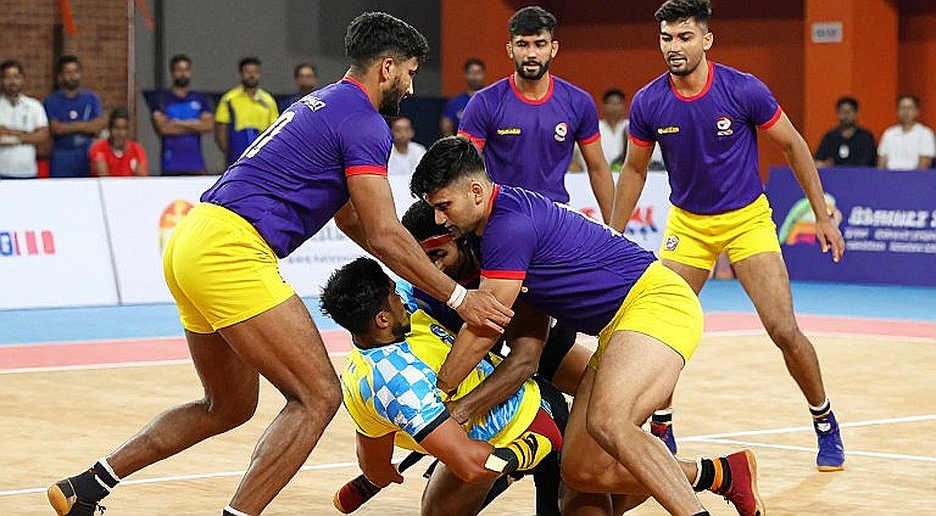
Kabaddi is easy to watch and far harder to read. A raider has thirty seconds, and throughout them must keep chanting kabaddi-kabaddi while breathing — the moment the breath breaks, the raid ends. That single rule turns the sport into an extraordinary test of endurance. The do-or-die raid is attack-or-survive: the raider must reach the last defender, scoring two points on success and conceding one on failure.
Defence has its own vocabulary. When only one or two defenders remain on the mat and they still bring the raider down, it is a super tackle, worth two points — the rule that keeps a depleted team alive in the contest. Dismissing every opposition player yields two additional all-out points, a moment that frequently swings a match. Touching the bonus line on the way back, respecting the lobby boundary and creating space for a partner raider together form a strategic frame in which decision-making matters more than raw strength.
THE STARS WHO BECAME THE SPORT'S IDENTITY
Much of the popularity belongs to individual players. Pardeep Narwal's raiding set league scoring records over a long stretch; the dubki and the flexibility of his body's lean became a signature language of kabaddi. Anup Kumar taught a generation of Indian kabaddi, through shrewdness and calm leadership, that patience matters more than force. Ajay Thakur's raids in decisive moments, Manjeet Chhillar's cutting edge in defence and Rohit Kumar's aggression each shaped the team's direction in their own era.
Fazel Atrachali, arriving from Iran, proved the league is not a platform for Indian players alone. Newer raiders such as Naveen Kumar showed that the league has become a genuine pipeline, carrying players directly to the national side. Stylistic diversity also draws attention — against the traditional bold raider stands a separate model built on patience and technique.
WOMEN'S KABADDI: A FAST START, THIN INVESTMENT
Women's kabaddi has found success on the international stage — at Asian Games and World Cups the Indian women's team has stayed consistently within medal range. But at a price in visibility: a large, broadcast-based tournament comparable to the men's league has not yet taken root. The consequences are direct — less media coverage, less sponsorship and limited professional options for players. The performance is there; what women's kabaddi needs is a regular platform that carries that performance to audiences.
CHALLENGES THAT SLIP BEHIND THE NUMBERS
Alongside the success story sit structural problems. First, grassroots infrastructure — in most states, kabaddi training depends on government sports complexes and local academies where scientific fitness training is still the exception. Second, governance and transparency — national federation elections, selection processes and financial accounting have repeatedly been disputed, and that erodes player trust. Third, scouting — much of the league's success has come from a handful of well-organised centres, while the rural talent pool is far larger and the system for reaching it remains informal.
A fourth challenge is the shift to mat-based play. Most international competitions are now held on synthetic mats, which makes the sport faster and better controlled for injury management — but is harder to adapt to for players raised on mud courts. Speed, grip and friction all change, with a direct effect on tackling technique.
THE ROAD AHEAD
Kabaddi is one of the rare sports with a large audience base connected to its roots. The next step is not expansion but structure: a solid domestic circuit where players have matches to play outside the league; the establishment of a women's league; fitness and injury-management training at district level; and a public, analysable database of performance statistics. If those four things are addressed, kabaddi can become not merely a popular Indian sport but a globally competitive one — with a level of rivalry considerably higher than today's.
संबंधित खिलाड़ी
लोकप्रिय/पसंदीदा पुस्तकें
Kabaddi: From India's Soil to the Global Stage — The Complete Story of a Sport2026-11-02
Kabaddi's Shifting Tactics: From the Mud Pit to the Mat, From Brawn to Brain2026-11-02
Commonwealth Kabaddi Championship 2026 in Ahmedabad from October 23: The Real Answer Is Not in the Medal Table, It Is in the Broadcast Line2026-10-30
Surjeet Singh Captain, Naveen Kumar Vice-Captain: India's Real Test in Ahmedabad Is Bigger Than the Leadership Label2026-10-28
Commonwealth Kabaddi Championship 2026: Questions Over India's Rhythm, Big Win Expected Against Nigeria2026-10-27
The 46 and the 45: What the Scoreboard Said Before India vs Uganda — and What 'Commonwealth' Hid2026-10-26
The 'Convincing' 46-26 Win That Is Actually a Warning — India vs Uganda Preview2026-10-25
Fourth in the Points Table, Without Having Played a Single Match2026-10-25
अनुशंसित
India vs England, Match 4: What the Ahmedabad Scoreboard Will Show, and What It Never Can2026-10-24
Railway Jobs Before Player Auctions: Kabaddi's Two Ledgers and the Real Truth of the Transfer Window2026-11-03
Before India vs Nigeria, the truth in the scorecard: the real Commonwealth Kabaddi story between 46-26 and 18-682026-10-28
India vs Uganda: At the Commonwealth Kabaddi Championship, the Real Question Is the Field, Not the Score2026-10-25
The 46 and the 45: What the Scoreboard Said Before India vs Uganda — and What 'Commonwealth' Hid2026-10-26
The Dead-Raid Economy: How the Third Defender and the 30-Second Clock Are Deciding the Regular Season2026-10-31
Commonwealth Kabaddi Championship 2026 in Ahmedabad from October 23: The Real Answer Is Not in the Medal Table, It Is in the Broadcast Line2026-10-30
Kabaddi: From the Village Akhara to a Global Sports Economy2026-11-02
अनुशंसित
Before India vs Nigeria, the truth in the scorecard: the real Commonwealth Kabaddi story between 46-26 and 18-682026-10-28
The 46 and the 45: What the Scoreboard Said Before India vs Uganda — and What 'Commonwealth' Hid2026-10-26
Kabaddi: From Mud Courts to Synthetic Mats, a Village Sport's Professional Journey2026-11-03
Commonwealth Kabaddi Championship: Ahmedabad Hosts From October 23, but the 'Where to Watch Free' Page Is Still Blank2026-11-02
Commonwealth Kabaddi Championship 2026: Questions Over India's Rhythm, Big Win Expected Against Nigeria2026-10-27
Commonwealth Kabaddi Championship 2026, India vs England (Match 4): Three Lines on the Team Sheet the Scoreboard Will Never Show2026-10-30
Surjeet Singh Named India Captain, Naveen Kumar Deputy for Commonwealth Kabaddi Championship 2026 — Full Picture, Tactics and the Unanswered Questions2026-11-02
India 46-26 England: Not a Win but a Warning — and the Borrowed 'Commonwealth' Badge2026-10-25
अनुशंसित
Commonwealth Kabaddi Championship 2026 in Ahmedabad from October 23: The Real Answer Is Not in the Medal Table, It Is in the Broadcast Line2026-10-30
Surjeet Singh Captain, Naveen Kumar Vice-Captain: India's Real Test in Ahmedabad Is Bigger Than the Leadership Label2026-10-28
Before India vs Nigeria, the truth in the scorecard: the real Commonwealth Kabaddi story between 46-26 and 18-682026-10-28
India vs Uganda: At the Commonwealth Kabaddi Championship, the Real Question Is the Field, Not the Score2026-10-25
Commonwealth Kabaddi Championship 2026, India vs England (Match 4): Three Lines on the Team Sheet the Scoreboard Will Never Show2026-10-30
The Dead-Raid Economy: How the Third Defender and the 30-Second Clock Are Deciding the Regular Season2026-10-31
The 46 and the 45: What the Scoreboard Said Before India vs Uganda — and What 'Commonwealth' Hid2026-10-26
Ahmedabad Match 4: India Will Win, and the Scoresheet Will Still Hide the Bigger Truth2026-10-28