
होमKabaddiKabaddi's Second Coming: From Clay Courts to the Pro League, the New Economy of India's Second Sport
Kabaddi's Second Coming: From Clay Courts to the Pro League, the New Economy of India's Second Sport
कबड्डी ने 2014 में प्रो कबड्डी लीग की शुरुआत के बाद ग्रामीण खेल से एक व्यावसायिक उत्पाद में बदलाव किया, जिससे खिलाड़ियों की आय, प्रशिक्षण पद्धति और प्रसारण-दृश्यता बदली। अंतरराष्ट्रीय स्तर पर 1990 के एशियाई खेलों में शामिल होने के बाद भारत का दबदबा रहा, लेकिन 2018 के एशियाई खेलों के पुरुष फ़ाइनल में ईरान की जीत ने प्रतिस्पर्धा का नया संतुलन दिखाया। मुख्य चुनौतियाँ हैं लीग और राष्ट्रीय टीम के कैलेंडर का टकराव, असमान राज्य-स्तरीय ढाँचा, महिला कबड्डी में सीमित संसाधन, और खिलाड़ियों के कार्यभार प्रबंधन पर स्पष्ट नीति का अभाव।
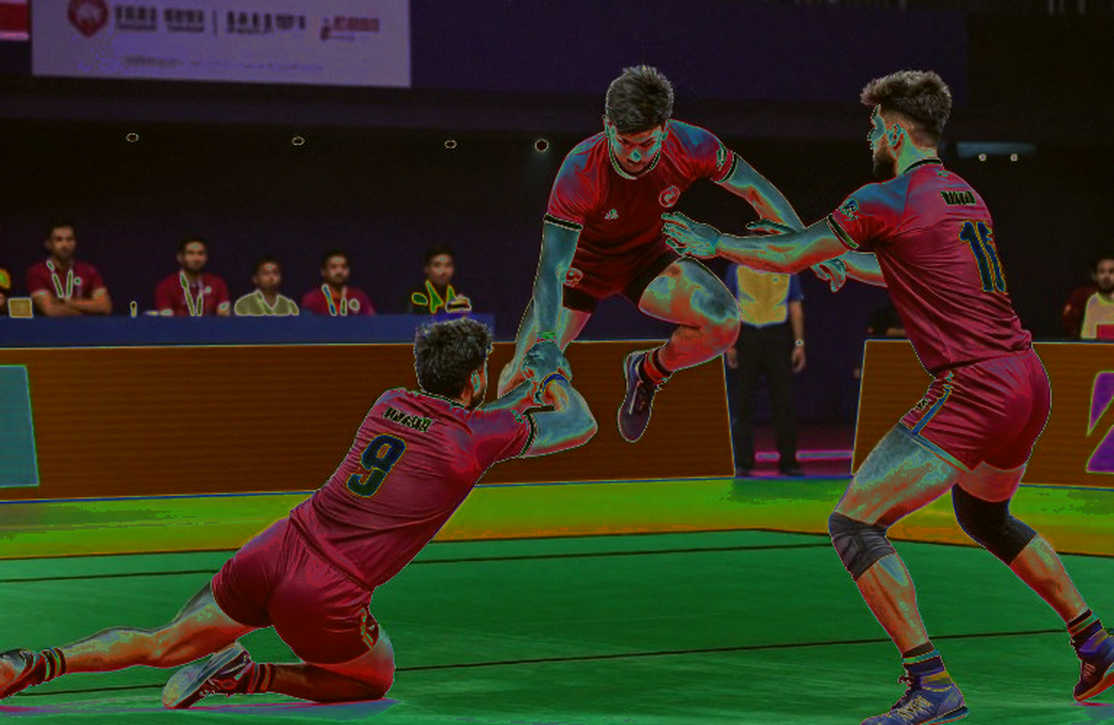
It is six in the morning. Outside almost any village in the country, you will find twenty-odd boys standing in an empty field. No boundary line, no referee, no scoreboard. One man draws 'kabaddi-kabaddi' in a rhythmic breath, the rest repeat it behind him and move toward the line on the far side. Sand, sweat and a chalk mark: that is the oldest image of kabaddi. But the same sport has a second image, inside air-conditioned urban arenas with mats on the floor, floodlights overhead, and a media plan already prepared before a single night's fixture. Kabaddi today is two sports at once, one played every day in villages and one that has become a broadcast product for tens of millions.
The root of that shift lies in the simplicity of the rules. Kabaddi needs no expensive equipment, no large ground, no specific climate. One line, eleven players and the discipline of holding your breath. That is why the sport has penetrated parts of India where other games have barely reached beyond formal structures. But simplicity and commercialisation are different things. Simplicity made the sport popular; commercialisation turned it into an industry.
When the Pro Kabaddi League launched in 2026, it began with eight franchises. The league has since expanded to twelve teams and is counted among the most-watched sporting properties in India. The idea behind it was explicit: turn the game into entertainment product, not just competition. The building blocks were borrowed from cricket, with city-based teams, a player auction, a large broadcaster deal, and marketing that framed every match as an event. The result was that kabaddi reached households that had previously known it only as a school game.
The league changed the income structure for players. Athletes who once depended on state-level jobs and government department teams now attract bids at auction, sign contracts and sell their performance directly in a market. This did two things. First, it made a livelihood possible for players from small towns and rural backgrounds. Second, it brought a new professional culture, with fitness trainers, physios, video analysts and performance managers now part of a team, something previously unthinkable at this level.
Technically, kabaddi is now measured the way other professional sports are. Raids, tackles, do-or-die raids, super tackles, area-clearing strategy: all of it is logged, and pre-match reports are built around the opponent's patterns. Once a coach's experience and a player's instinct were decisive. Now decisions are made with data. That shift is not small. It has made the game more planned, but it has also challenged players who grew up trusting raw instinct.
At the international level, the story is different, and the balance is shifting. After kabaddi received official status at the 2026 Asian Games, India's dominance in the men's event remained largely uncontested for a long period, and India also won the 2026 World Cup. But when Iran beat India in the men's final of the 2026 Asian Games, the message was not merely one defeat. It signalled that kabaddi is no longer a one-sided sport. Iran's strength lies in physical preparation and defensive discipline, India's in raiding depth and experience. That rivalry has created practical pressure to globalise the game, because lopsided dominance limits any sport's market.
Inside India, the supply chain of kabaddi begins in villages and small towns. The first tier of talent is local tournaments, often held around fairs, festivals or the months after harvest. Above that sit district and state competitions, and then the league's selection cycle. The problem is that this chain is uneven. Some states have strong structures, others have almost none. As a result, a large number of talented players remain invisible not because they lack ability, but because they have no stage on which to be seen.
Women's kabaddi has followed a somewhat different path. After a women's event was included at the 2026 Asian Games, an international competitive structure took shape here as well, and the visibility of women players improved domestically. Yet compared with the men's game, resources, broadcast exposure and sponsorship remain limited. That gap is not only economic but structural: women players frequently confront questions of social acceptance and safety during the most decisive years of a career.
And then there is the side on which the league's gloss wears thin: administration. International governance sits with the International Kabaddi Federation, while the domestic structure in India runs through the Amateur Kabaddi Federation of India. The league's priorities and the federation's are not always the same. The league's interest is in a commercial calendar; the federation's in the national team and international competition. When the two collide, the heaviest cost falls on the player's body. Congested schedules, inadequate recovery time and pressure to play through injury are three issues on which professional kabaddi still lacks a concrete, publicly stated policy.
Even so, the path kabaddi has taken is unique in Indian sport. This is a game that built a distinct identity almost entirely on the strength of market and television, without any large state-driven campaign. And that is also its greatest risk. Where a sport's foundation rests on a commercial league, any deterioration in broadcast rights value or sponsorship arithmetic transmits directly to the levels below.
There are three clear routes forward. First, synchronise the league and national team calendars to manage player workload. Second, invest in state-level structures so that talent identification is not confined to one league's trials. Third, build a separate and durable broadcast and sponsorship framework for women's kabaddi, because funding does not arrive without visibility and visibility does not build without funding.
Kabaddi found its first identity in village fields. It built a second in the floodlights of stadiums. The question now is whether it can keep both alive at once, or whether the momentum of the market will cut it away from the very soil it took off from.
संबंधित खिलाड़ी
लोकप्रिय/पसंदीदा पुस्तकें
Commonwealth Kabaddi Championship 2026 in Ahmedabad from October 23: The Real Answer Is Not in the Medal Table, It Is in the Broadcast Line2026-10-30
Surjeet Singh Captain, Naveen Kumar Vice-Captain: India's Real Test in Ahmedabad Is Bigger Than the Leadership Label2026-10-28
Commonwealth Kabaddi Championship 2026: Questions Over India's Rhythm, Big Win Expected Against Nigeria2026-10-27
The 46 and the 45: What the Scoreboard Said Before India vs Uganda — and What 'Commonwealth' Hid2026-10-26
The 'Convincing' 46-26 Win That Is Actually a Warning — India vs Uganda Preview2026-10-25
Fourth in the Points Table, Without Having Played a Single Match2026-10-25
India vs England, Match 4: What the Ahmedabad Scoreboard Will Show, and What It Never Can2026-10-24
Kabaddi's Second Coming: From Clay Courts to the Pro League, the New Economy of India's Second Sport2026-11-01
अनुशंसित
Commonwealth Kabaddi Championship 2026, India vs England (Match 4): Three Lines on the Team Sheet the Scoreboard Will Never Show2026-10-30
India 46-26 England: Not a Win but a Warning — and the Borrowed 'Commonwealth' Badge2026-10-25
Commonwealth Kabaddi Championship 2026: India vs England — The Real Data Is on the Team Sheet, Not the Scoreboard2026-10-25
Commonwealth Kabaddi Championship 2026, Day 1: The Points Table Isn't Telling You What You Think2026-10-25
Kabaddi's Second Coming: From Clay Courts to the Pro League, the New Economy of India's Second Sport2026-11-01
Fourth in the Points Table, Without Having Played a Single Match2026-10-25
Commonwealth Kabaddi Championship 2026 in Ahmedabad from October 23: The Real Answer Is Not in the Medal Table, It Is in the Broadcast Line2026-10-30
India vs England, Match 4: What the Ahmedabad Scoreboard Will Show, and What It Never Can2026-10-24
अनुशंसित
Before India vs Nigeria, the truth in the scorecard: the real Commonwealth Kabaddi story between 46-26 and 18-682026-10-28
Commonwealth Kabaddi Day 1: Why Three Teams That Never Stepped on the Mat Already Sit Mid-Table2026-10-25
India vs Uganda: At the Commonwealth Kabaddi Championship, the Real Question Is the Field, Not the Score2026-10-25
The Jakarta Silence and Kabaddi's Unkept Ledger: Iran's System, India's Reputation2026-10-28
Kabaddi's Second Coming: From Clay Courts to the Pro League, the New Economy of India's Second Sport2026-11-01
Two Kabaddis, One Ledger: The Mud Floor, the League Lights and the Truth of the Training Ground2026-10-25
Commonwealth Kabaddi Championship 2026, India vs England (Match 4): Three Lines on the Team Sheet the Scoreboard Will Never Show2026-10-30
Commonwealth Kabaddi Championship 2026: Questions Over India's Rhythm, Big Win Expected Against Nigeria2026-10-27
अनुशंसित
Fourth in the Points Table, Without Having Played a Single Match2026-10-25
India vs England, Match 4: What the Ahmedabad Scoreboard Will Show, and What It Never Can2026-10-24
The Jakarta Silence and Kabaddi's Unkept Ledger: Iran's System, India's Reputation2026-10-28
Ahmedabad Match 4: India Will Win, and the Scoresheet Will Still Hide the Bigger Truth2026-10-28
The Dead-Raid Economy: How the Third Defender and the 30-Second Clock Are Deciding the Regular Season2026-10-31
India 46-26 England: Not a Win but a Warning — and the Borrowed 'Commonwealth' Badge2026-10-25
Commonwealth Kabaddi Championship 2026, India vs England (Match 4): Three Lines on the Team Sheet the Scoreboard Will Never Show2026-10-30
Kabaddi's Second Coming: From Clay Courts to the Pro League, the New Economy of India's Second Sport2026-11-01